

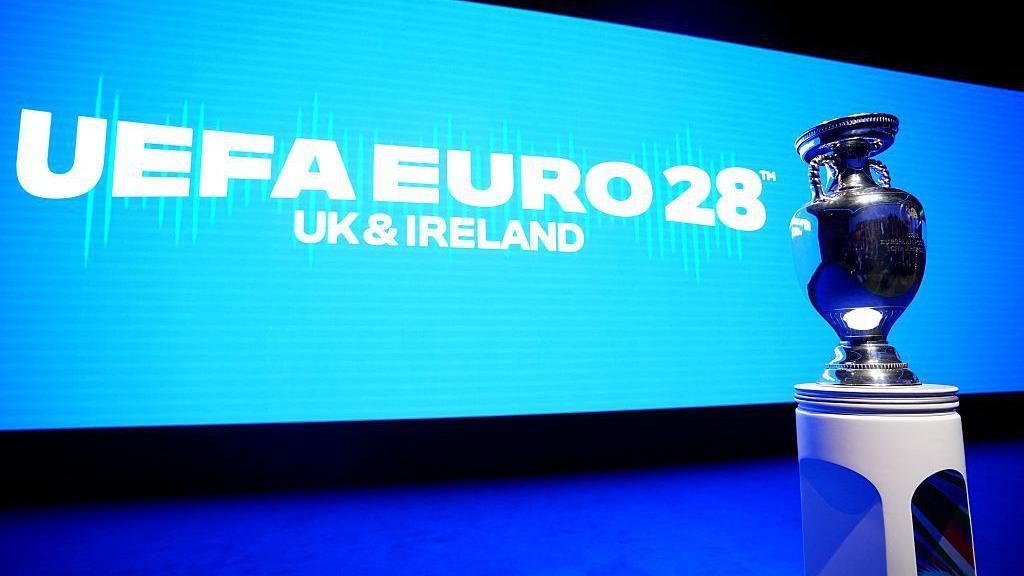
Euro 2028 will unfold in nine stadiums throughout the United Kingdom and Ireland.
Uefa will broadly freeze ticket prices for the 2028 European Championships – meaning supporters could purchase a group of five at the cost of a single car parking spot at a World Cup stadium in the US during the upcoming tournament.
The Euros in England, Scotland, Wales and the Republic of Ireland will feature 40% of tickets reserved for the two lowest-priced "Fans First" categories.
During the last European Championship in Germany, the most affordable tickets for the initial matches cost 30 euros (£26) and 60 euros (£52). Uefa aims to maintain these under thirty and sixty pounds each for the 2028 edition.
There will be four pricing tiers altogether, plus a small number of VIP+ tickets which will provide the funding to keep costs stable for general fans.
Match tickets for the group phase in the more expensive bands at the previous tournament cost €150 (£130) and €200 (174 pounds). No detail on pricing at this level has yet been confirmed.
A Sharp Difference in Pricing Policy
It is a stark contrast to the controversial ticket pricing strategy at this summer's World Cup in the United States, Mexico and Canada.
The cheapest matches in the group phase for England were originally priced at $220 (167 pounds), while the priciest at 700 dollars (523 pounds).
Fans at Euro 2028 could potentially see every one of the three group stage matches at the Euros for the cost of a single category three FIFA World Cup admission.
The world football body eventually bowed to pressure over its pricing and introduced a highly restricted quantity of 60-dollar (45-pound) tickets for all 104 matches.
Beyond Tickets: The Parking Premium
However, that represents only the beginning in terms of prices at the World Cup.
Reports indicate that the typical fee for a parking space at a World Cup match in the US is currently 175 dollars (£133). Spaces for group-stage games at the New Jersey stadium near New York cost 225 dollars (171 pounds).
Allocation & Accessibility
Organisers have pledged to set aside ten thousand passes for each country for each group stage fixture.
In contrast, the World Cup organisers provided fewer than four thousand tickets to every national team at the FIFA event, despite the majority of venues being bigger.
Controversially, authorities have used fluctuating pricing models throughout its sales periods, leading to costs rising even higher.
The European tournament will not have variable pricing and officials have assured that approximately 50% of tickets will be reasonably priced.
Accessibility for Fans with Disabilities
This has extended to controversy regarding the costs for disabled fans, too. For the FIFA event fans are required to pay the complete ticket price and they do not receive a complimentary pass for a personal assistant.
At Euro 2028, disabled supporters can access the cheapest categories and can apply for a complimentary ticket for a companion.
Resale Markets
The official resale price for UEFA is set at face value, whereas FIFA tickets can be resold on a secondary market at markedly higher costs, with Fifa taking a thirty percent commission on top of that.
Complete details of admission costs and sale periods for the championship are to be revealed in the fall of 2027, with initial sales opening following the group stage draw in December of that year.
Similar to the global tournament, costs for tickets for Euro 2028 are expected to increase during the elimination stages.
However, admission for the semi-finals and final of the European Championship will be nothing like those for the World Cup.
Supporter value tickets for the MetLife Stadium are priced at over three thousand pounds. At Euro 2024, the equivalent category of tickets was priced at 95 euros (£82.50).
2028 European Championship Stadiums and Locations
- In England: Everton Stadium, Manchester City Stadium, St James' Park, Spurs' arena, Aston Villa's home, Wembley Stadium.
- Scotland: Hampden Park, in Glasgow.
- Wales: National Stadium of Wales, Cardiff.
- Republic of Ireland: The Aviva Stadium, in Dublin.


